 Algae Outer Hebrides
Phylum: Charophyta Family: Desmidiaceae
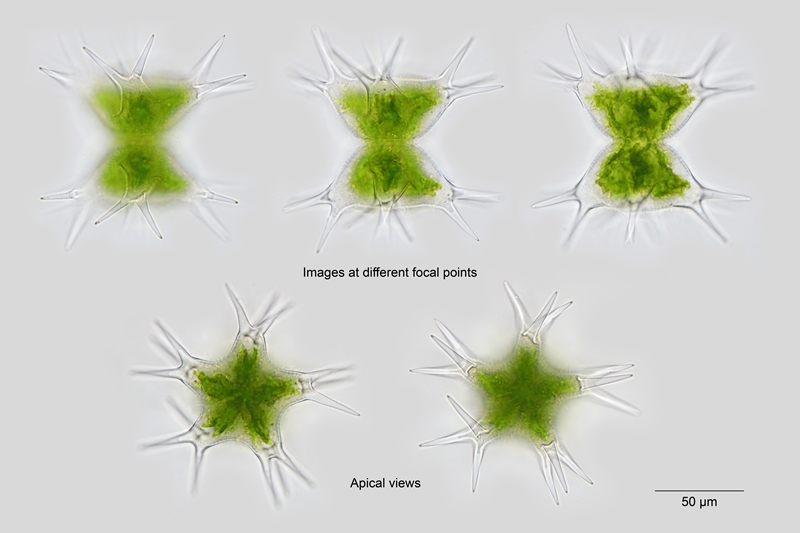
Staurastrum brasiliense var. lundellii W. & G.S.West 1896
A spectacular and large desmid with a wide-open sinus. Semicells cuneate with sides and apex more or less straight. A 5-radiate taxon with the apical angles supporting three stout spines, two are generally placed horizontally, and the third is inserted above them at an angle.
It differs from the nominate variety in being almost twice the size and 5-radiate. St. brasiliense Nordstedt 1870 is predominantly (entirely?) 4-radiate. When the Wests (1900: 259) named this variety, they commented: “The plant which we have seen commonly from N. America, Ireland, and N. Wales is sufficiently different from the Brazilian type to rank as a distinct variety.” I would go further and suggest it warrants species rank.
Single cell dimensions: L: 77 µm; B: 69 µm; Is: 35 µm; Sp: 25-31 µm; Overall LxB: 116 x 119 µm.
In the Wests (l.c.) time it was relatively common in the plankton of moorland lochs, but it is much scarcer now.
References:
West, W. & West, G.S. (1896). On some North American Desmidieae.
West, W., West, G.S. & Carter, N. (1923). A Monograph of the British Desmidiaceae, Volume 5.